Gulfton, Houston's Hottest Neighborhood, Turns to Trees, Shade Structures and Better Transit
Residents and partner groups are pursuing shade, greenery and improved bus service in Gulfton, where a 2020 NOAA study found some of the city's highest temperatures.
By Kendra Konchanuk ·
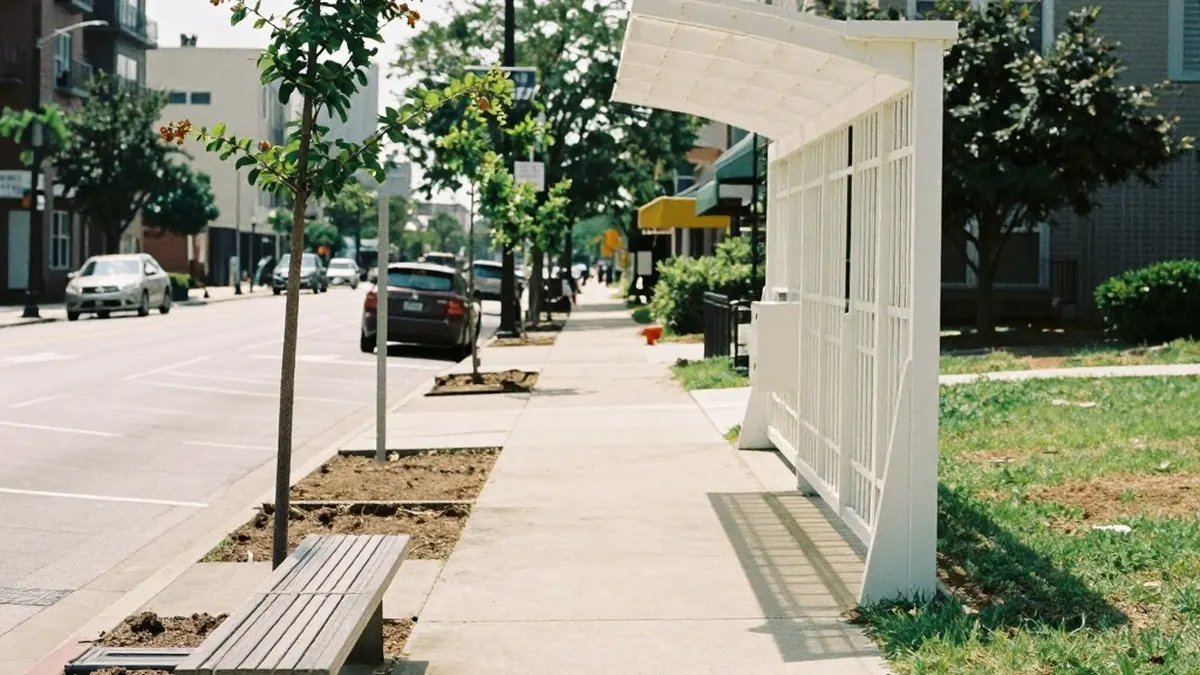
On a typical morning at the corner of Gulfton and Rampart Streets, the sidewalks fill with people heading to school, to the grocery store or to the neighborhood's only park. Sandra Rodriguez, president of the Super Neighborhood in Gulfton, has lived most of her life in the area and says it is one of the busiest intersections around.
The area in Southwest Houston is among the most transit-dependent in the city, according to the latest equity report from LINK Houston. Rodriguez points to hazards that drivers may overlook but pedestrians feel directly: few trees, narrow sidewalks and a bus stop with no shade. On June 19, when the afternoon heat index reached 115 degrees, she said the heat was already noticeable at 11 a.m.
A 2020 heat mapping study by the National Oceanic and Atmospheric Administration found Gulfton to be the hottest neighborhood in Houston, at times 17 degrees hotter than other parts of town. An analysis of data by Rice University's Kinder Institute for Urban Research found that just 4% of parts of Gulfton is shaded by trees, compared with more than 40% tree canopy in areas such as West University.
About a half dozen outside organizations have partnered with residents in recent years to cool and improve the neighborhood. The Greener Gulfton Plan, developed by the Nature Conservancy and community groups, centers on trees. But a Texas A&M Forest Service study identified only 800 possible planting spots, which would raise canopy by roughly 2 to 3 percent. Cramped sidewalks and extensive concrete leave little room, and a tree needs at least three feet of planting space to thrive.
Jaime Gonzalez of the Nature Conservancy called 800 trees a good first step but not enough to cool the neighborhood, particularly as climate change intensifies heat and humidity. He said the solution will need a mix of tree planting and shade structures.
Local architecture firm Ultrabarrio has produced a mock-up of adjustable white trellises that could shade sidewalks too narrow for trees. They would likely go on busy pedestrian streets or near bus stops that cannot fit a standard shelter, and their slanted design is meant to maximize shade based on the sun's position. The design also includes a bus shelter with a green roof and light-colored paint to reflect heat. Architect Marcus Martinez said the designs are meant to start a conversation rather than serve as a final plan.
The designs are part of an effort with LINK Houston, a transportation advocacy group. Peter Eccles, its director of policy and planning, said the "rest stops" would incorporate nature, offer seating and possibly wifi, with relief from the sun as the main aim. He noted that heat exposure could lead people to avoid transit, potentially causing them to miss medical appointments or economic opportunities. Gulfton is a pilot, and the group hopes to replicate the strategies elsewhere in the city.
The work builds on other transit efforts. Metro is bringing a rapid bus line to Gulfton for more frequent service and shorter waits at stops. The Gulfton Circulator began service in 2021, and safety improvements have been made along the Hillcroft Avenue corridor.
Gonzalez said residents also value nature for its own sake, noting that many grew up in natural environments in their home countries and want their children to experience it. Maria Hernandez, founder of Madres del Parque, has spent more than six years working to improve Burnett Bayland Park, Gulfton's only park. Two soccer pitches were recently installed with an initial $150,000 investment, and Harris County Precinct 4 is helping find funding for a master plan being drafted. A spokesperson for Commissioner Lesley Briones' office said the county plans to double the park's footprint using publicly owned land to the south.
Rodriguez views 2017, when Gulfton was chosen as one of the City of Houston's first Complete Communities, as a turning point. She said the city then lacked money to carry out the projects residents wanted, but the process of asking residents directly produced a formal list of needs that organizers now use with outside groups and government offices. "Now, all we need is funding to be able to fulfill these projects," she said.
Source: Houston Public Media